
Introduction
Bonded Warehouses in India: A Strategic Growth Lever for Global Brands is more than just a policy tool—it marks a strategic shift in how global brands in India are redefining logistics, taxation, and supply chain agility. As India advances toward its $5 trillion economic vision, bonded warehouses in India are playing an increasingly vital role in enabling seamless trade, optimizing landed costs, and accelerating market access.
These facilities—authorized by Indian Customs—allow goods to be stored without the immediate burden of duties, providing unmatched flexibility in managing inventory and cash flows. Strategic warehousing in India is no longer just about infrastructure; it’s a critical enabler of global expansion, particularly for sectors like electronics, spirits, and luxury fashion. From easing last-mile delivery to deferring customs costs, bonded warehouses in India offer a unique operating model tailored to the demands of a globally integrated economy. These also form a critical component of the evolving duty-free storage India ecosystem, supporting capital efficiency and risk management.
1. What Are Bonded Warehouses and Why They Matter in India’s Growth Story
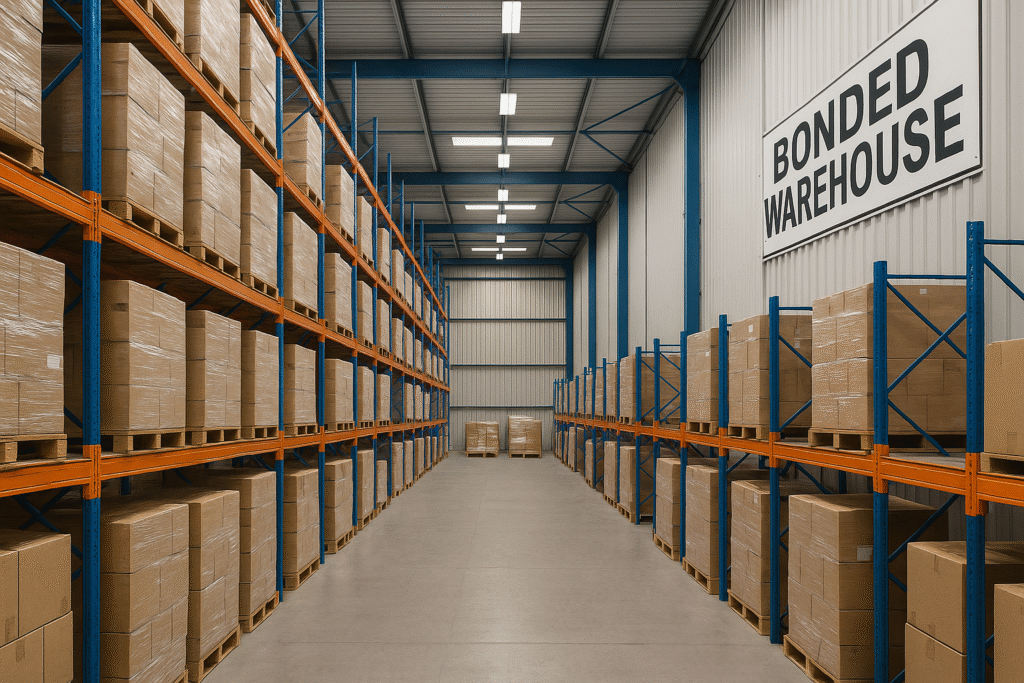
Bonded warehouses in India are not just storage facilities—they are strategic economic tools enabling companies to manage inventory, defer duties, and enhance operational agility. A bonded warehouse is a secured zone approved by Indian Customs where imported goods can be stored without the immediate payment of customs duties. Duties are levied only when these goods are cleared for domestic consumption, giving companies significant breathing space in terms of cash flow and tax planning. This model is at the heart of duty-free storage India, offering businesses unparalleled financial control.
In a rapidly growing economy like India—projected to expand at 6.5% annually (IMF, 2024)—bonded warehousing in India is emerging as a pillar of modern trade and logistics infrastructure. According to a report by Invest India, the warehousing sector in India is expected to touch $34.99 billion by 2027. Within this, bonded warehouses in India are seeing growing demand, especially from industries like electronics, liquor, automotive parts, luxury fashion, and aerospace components—sectors that often deal with high-value or high-duty imports.
One of the key reasons bonded warehouses in India matter in the country’s growth story is their ability to support distributed supply chains. With global trade flows being reconfigured post-pandemic, many multinational corporations are using India not just as a consumption market, but as a re-export and light assembly hub. In such scenarios, bonded warehouses in India offer the flexibility to store goods close to demand centers while avoiding immediate duty payments. Goods can also be partially assembled or relabeled before re-export, enhancing operational value.
Another important factor is that bonded warehouses in India allow companies to respond to market demand without locking up working capital. This flexibility is crucial, particularly in high-margin sectors where upfront customs duties can severely impact profit margins. Furthermore, these facilities enable companies to consolidate their imports, reducing freight costs and simplifying documentation under customs supervision—an integral part of duty-free storage India initiatives.
The value proposition becomes even more powerful when bonded warehousing in India is coupled with automation, digitized inventory management, and integration into multi-modal logistics parks. Government schemes like the Gati Shakti National Master Plan and the Logistics Efficiency Enhancement Program (LEEP) are laying the groundwork for improving accessibility and standardizing duty-free storage India infrastructure.
In short, bonded warehouses in India are bridging the gap between global supply chains and local market demand—making them indispensable for the country’s long-term economic strategy.
2. Rising Demand for Bonded Warehousing
India’s bonded warehousing landscape is undergoing a quiet revolution, driven by booming sectors like e-commerce, manufacturing, and 3PL logistics. As global brands in India aim to stay agile in a high-demand, cost-sensitive market, bonded warehouses in India have emerged as a strategic asset for optimizing supply chains. From streamlining import handling to reducing duty burdens and improving delivery responsiveness, their relevance is more crucial than ever.
In e-commerce, where speed, cost efficiency, and agility are non-negotiable, bonded warehousing in India has emerged as a critical enabler for global brands entering the Indian market. As per Business Standard, India’s e-commerce sector is expected to grow exponentially from $124 billion in 2024 to $550 billion by 2035. This growth is being propelled by rising smartphone penetration, the expansion of digital payments, and a sharp increase in cross-border shopping. These trends have triggered surging demand for imported electronics, fashion, luxury goods, and other high-value accessories. For global D2C and B2C players, the ability to store goods in bonded warehouses in India near consumption hubs—particularly in metro and Tier 1 cities—offers a strategic advantage. By deferring customs duties until the point of domestic sale, these players can reduce inventory holding costs while responding swiftly to market demand.
Bonded warehouses in India not only improve cash flow by eliminating the need for upfront tax payments but also support better inventory rotation and seasonal planning—both critical in e-commerce’s high-SKU, fast-moving environment. Importers can hold goods closer to customers without locking up working capital, which allows them to test new products or run promotional campaigns with greater flexibility. Moreover, this model strengthens reverse logistics capabilities: unsold stock can be re-exported or redirected to alternate markets without incurring additional duties. This level of operational agility is particularly valuable for brands dealing in volatile or trend-driven categories, where speed-to-market and adaptability often determine market success. As e-commerce continues to evolve in India, bonded warehousing in India is fast becoming a backbone of scalable and profitable fulfillment strategies.
In the manufacturing sector, bonded warehouses in India provide significant tactical advantages, especially for industries such as automobiles, electronics, heavy machinery, and pharmaceuticals—where imported components are essential for local assembly. These businesses benefit from deferred customs duties, allowing them to store critical inputs in bonded warehouse facilities until production demands arise. This model minimizes capital blocked in taxes, offering greater financial flexibility while enabling demand-linked manufacturing. According to ICRA, warehousing demand from the manufacturing sector has witnessed double-digit growth post-COVID, with bonded warehouses in India increasingly favored near SEZs and industrial corridors to support just-in-time production and rapid integration into supply chains.
India’s manufacturing resurgence is further supported by strategic government initiatives like the Production-Linked Incentive (PLI) schemes and the Make in India campaign, which aim to attract global OEMs and Tier 1 suppliers. Bonded warehousing in India plays a vital role in these initiatives by facilitating multi-country sourcing strategies—allowing companies to consolidate global shipments without incurring immediate tax liabilities. This is especially valuable in today’s volatile global trade environment, where flexibility and responsiveness are key. By leveraging bonded warehouses in India near major industrial hubs, manufacturers can streamline their operations, reduce lead times, and mitigate supply chain risks—positioning India as a competitive, export-ready manufacturing base and a key player in duty-free storage India logistics.
Investor activity reinforces the growth trend. While traditional warehouses dominate the numbers, bonded warehouses in India are commanding premium pricing—especially those near major ports like JNPT (Navi Mumbai), Mundra (Gujarat), and Chennai. This rising preference is driven by their regulatory status, infrastructure, and ability to support value-added services such as labeling, kitting, and deferred clearance.
Simply put, bonded warehousing in India is no longer niche—it’s becoming mainstream across multiple high-growth sectors. Whether for faster e-commerce deliveries or streamlined manufacturing logistics, these facilities are now indispensable to companies targeting scalability and compliance in India’s dynamic trade environment.
3. Investor Confidence, Government Push & Policy Support: Fueling Bonded Warehouse Expansion
India’s bonded warehouse segment is riding a wave of investor confidence, strong government backing, and policy-led infrastructure momentum. Together, these forces are shaping an ecosystem where bonded warehouses in India are no longer a niche but a strategic pillar in India’s global trade aspirations and duty-free storage India landscape.
Investor Momentum
In 2024, India’s total warehousing demand reached 56.4 million sq. ft., a 12% increase over the previous year. Among this, bonded warehouses in India are commanding premium rents due to their location near ports and industrial clusters. Major metro cities like Mumbai, Chennai, and Kolkata are seeing heightened investor interest from global infrastructure funds, sovereign wealth investors, and real estate investment trusts (REITs).
What’s driving this bullish sentiment? Bonded warehouses in India offer consistent long-term leases, duty-deferral-linked cash flow advantages, and proximity to import-heavy trade zones. Their alignment with India’s growing role in global value chains, especially across electronics, EVs, chemicals, and luxury goods, makes them a strategic play in duty-free storage India investment portfolios.
Notably, leading private players and logistics park developers are exploring built-to-suit bonded warehouse facilities for multinational clients, signaling confidence in long-term demand. Many players are also investing in Grade A compliance-ready infrastructure that can be easily converted into bonded setups.
Government Push
India’s central government is actively supporting the bonded warehousing in India ecosystem through two core strategies:
- PM Gati Shakti and National Logistics Policy (NLP): These initiatives aim to reduce India’s logistics cost from ~14% of GDP to under 10% by enhancing multimodal connectivity, simplifying trade, and optimizing inventory movement. Bonded warehousing in India plays a vital role in achieving this target.
- Ease of Doing Business Reforms: Customs authorities are digitizing processes, enabling online bonding approvals, and facilitating electronic cargo tracking (ECT). These reforms reduce delays and enhance transparency in bonded warehouse operations.
Moreover, SEZ reforms, the PLI scheme, and the focus on FTAs (Free Trade Agreements) are all reinforcing the demand for duty-free storage India, especially as India looks to become a manufacturing alternative to China.
Policy & Regulatory Trends
While bonded warehousing in India remains governed under Section 58 of the Customs Act, 1962, recent policy direction emphasizes liberalization and flexibility. Key reforms include:
- Simplification of procedural compliance for warehouse license holders
- Introduction of warehouse-to-warehouse bonded transfers
- Removal of warehousing period caps for select sectors
- Encouragement for multi-user bonded warehouses in high-demand clusters
Despite these steps, several hurdles remain — particularly state-level regulatory bottlenecks, land acquisition delays, and the need for clearer digital customs workflows. However, the overall policy trajectory is clearly aligned with accelerating bonded warehousing in India as a competitive logistics lever.
4. Key Growth Drivers and Industry Challenges
India’s bonded warehouse segment sits at the crossroads of policy momentum, technological progress, and global trade realignment. While the growth story is strong, it’s not without headwinds. Let’s unpack the critical drivers and the underlying challenges shaping the future of bonded warehouses in India.
Key Growth Drivers
- Expansion of 3PL and Cold Chain Logistics
Third-party logistics (3PL) providers are driving demand for specialized infrastructure like bonded warehouses in India to offer value-added services for import-heavy industries such as pharma, electronics, and luxury goods. As the cold chain sector scales—especially in food and vaccine distribution—bonded cold storage becomes vital to store sensitive imported goods within duty-free storage India guidelines. - Nearshoring & India’s Role in Global Value Chains
India is increasingly being seen as a viable nearshoring destination. As a result, inbound shipments of raw materials and partially assembled products are on the rise. Bonded warehouses in India enable brands to hold inventory near manufacturing zones without triggering duties—supporting both Make in India and duty-free storage India objectives. - AI, Automation & Tech-Driven Warehouse Management
Modern bonded warehouses in India are integrating technologies like WMS, RFID, drones, and real-time tracking tools. These enhancements bring visibility and control across customs-linked operations and support India’s shift to digitally managed duty-free storage facilities. - Urban & Tier 2 Expansion
The reach of bonded warehouses in India is expanding beyond metros into Tier 2 cities and inland industrial zones, aided by projects like DFCs and logistics parks. This aligns with the decentralization of duty-free storage India infrastructure.
Industry Challenges
Despite momentum, bonded warehousing in India still faces several barriers:
- Land acquisition and zoning delays in high-demand zones
- Regulatory fragmentation across states despite central customs rules
- Workforce skill gaps, especially in tech-enabled bonded operations
- Incomplete customs digitization, especially for smaller bonded operators
The Path Forward
Addressing these challenges will require public-private coordination, continued digital transformation, and workforce upskilling. However, the market fundamentals remain strong, and with proper execution, bonded warehouses in India can set a global benchmark in duty-free storage India logistics and supply chain efficiency.