Supply chain risk refers to the possibility of disruptions, inefficiencies, or breakdowns occurring at any stage of the supply chain that can hinder the smooth flow of materials, information, or finished goods from origin to end customer. These risks may stem from internal operations, external dependencies, planning decisions, execution gaps, or structural weaknesses embedded within the supply chain.
Importantly, supply chain risks are not limited to sudden or highly visible disruptions. They also include slow-developing vulnerabilities such as over-reliance on specific suppliers, lack of end-to-end visibility, weak coordination between functions, inflexible network structures, or inadequate execution capability. When these risks are ignored or underestimated, they gradually weaken the overall system.
As supply chains become more interconnected and scale increases, the impact of these risks multiplies. A disruption at one point in the chain can trigger delays, cost overruns, service issues, and, in severe cases, a supply chain failure that affects the entire business. Understanding supply chain risk is therefore essential for identifying hidden vulnerabilities and explaining why seemingly stable operations can fail under pressure.
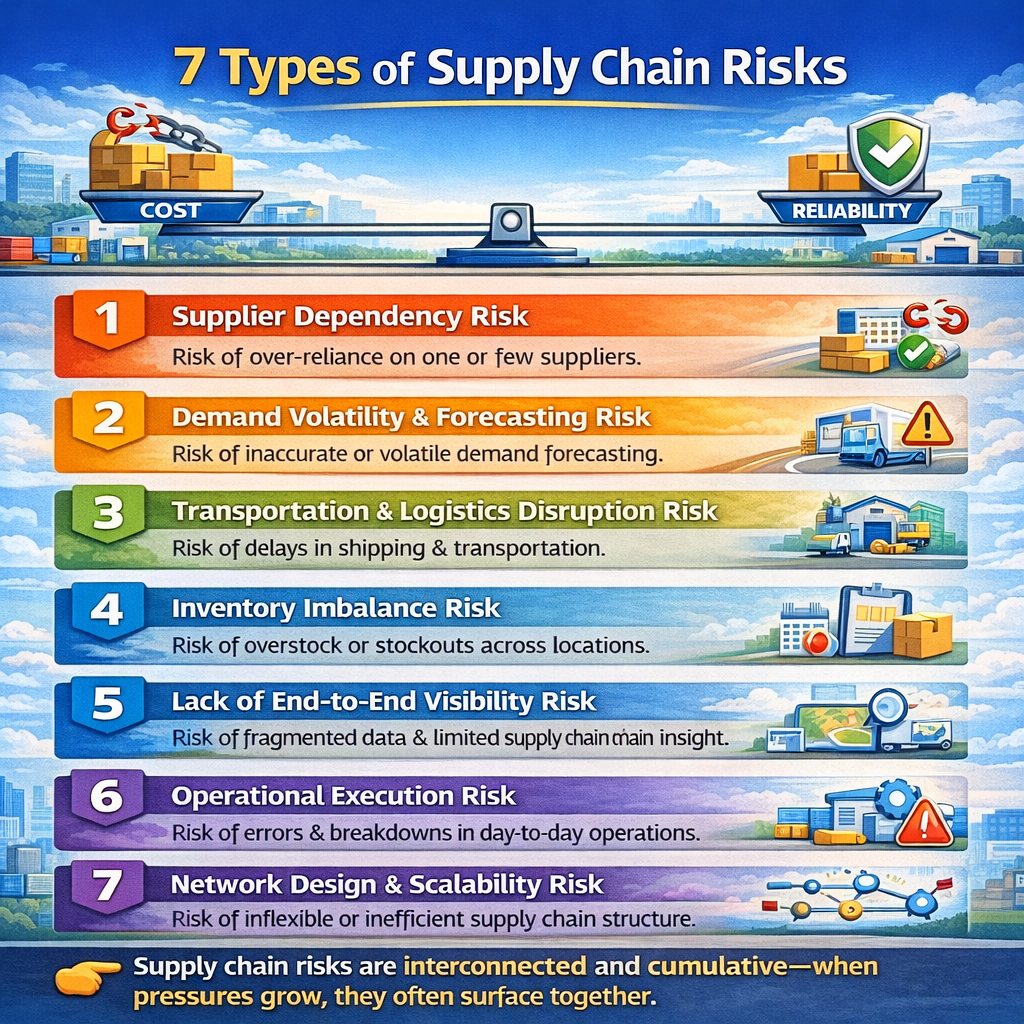
7 TYPES OF SUPPLY CHAIN RISKS
INTRODUCTION
7 Types of Supply Chain Risks explores the different ways vulnerabilities exist within a supply chain, often without being immediately visible. As businesses grow, supply chains expand in size, scope, and complexity. New suppliers are added, product portfolios broaden, markets widen, and operational dependencies multiply.
Many organizations associate supply chain risks primarily with external disruptions such as supplier delays or transportation issues. However, some of the most damaging risks originate internally—from planning assumptions, network design choices, execution capability, and coordination gaps across teams. These internal risks typically remain unnoticed during stable periods and surface only when demand fluctuates or operations come under stress, leading to a supply chain failure.
Recognizing the different types of supply chain risks enables businesses to move beyond reactive responses. Instead of firefighting isolated issues, organizations can understand why recurring supply chain challenges emerge and how they are linked to deeper structural weaknesses. The sections that follow examine each risk individually, explaining how it manifests in real operations and why it becomes more severe as businesses scale.
1. Supplier Dependency Risk
Supplier dependency risk is one of the most common supply chain risks, particularly in growing organizations. As businesses scale, they often reduce the number of suppliers to simplify coordination, improve pricing leverage, or maintain consistency. While this approach can deliver short-term efficiency, it creates structural vulnerability by concentrating supply exposure within a limited supplier base.
When a supply chain relies heavily on a single supplier—or a small group of suppliers—any disruption at that point directly affects continuity. Production delays, quality failures, capacity constraints, or compliance issues can halt material flow and disrupt downstream operations. Over time, this dependency emerges as one of the most critical types of supply chain challenges, especially during periods of demand growth or operational stress.
This risk often remains invisible during stable periods because supplier performance appears reliable. However, as volumes increase, flexibility reduces, alternative suppliers become harder to onboard quickly, and switching costs rise. What once seemed like a stable sourcing strategy can rapidly escalate into widespread supply chain challenges, significantly increasing the likelihood of a supply chain failure.
Mitigation Strategies for Supplier Dependency Risk
1. Supplier Diversification
Actively diversifying the supplier base across regions, capacities, or technologies reduces exposure to single-point failures. Even partial diversification improves resilience by ensuring that disruptions at one supplier do not stop operations entirely.
2. Development of Backup Suppliers
Identifying and qualifying secondary suppliers in advance strengthens response capability. Although these suppliers may not be used regularly, keeping them validated enables faster activation during disruptions and shortens recovery time.
3. Ongoing Supplier Risk Assessment
Regular evaluation of supplier performance, capacity, and reliability helps detect early warning signs. Monitoring lead times, quality trends, and dependency levels allows businesses to address vulnerabilities before they escalate into major supply chain risks.
2. Demand Volatility and Forecasting Risk
Demand volatility and forecasting risk is one of the most persistent supply chain risks, particularly for businesses operating in dynamic markets or experiencing rapid growth. As product portfolios expand and customer segments diversify, demand patterns become less predictable, reducing forecasting accuracy across the supply chain.
When demand signals are volatile or poorly understood, planning decisions become misaligned. Inventory is positioned incorrectly, production plans fluctuate frequently, and logistics resources are either underutilized or stretched beyond capacity. Over time, this mismatch between expected and actual demand becomes one of the most common types of supply chain challenges, directly affecting service levels and cost efficiency.
This risk is often underestimated because forecasting errors are treated as routine operational issues. However, at scale, even small inaccuracies can cascade into significant disruptions. Excess inventory accumulates in some areas while stockouts occur in others, creating recurring supply chain challenges that increase delays, expedite costs, and the risk of supply chain failure.
Mitigation Strategies for Demand Volatility and Forecasting Risk
1. Dynamic Demand Planning
Shifting from static forecasts to frequent demand reviews improves responsiveness. Updating plans based on recent sales trends and market signals helps align supply decisions with actual demand.
2. Cross-Functional Alignment
Closer coordination between sales, operations, and supply chain teams reduces bias in demand assumptions. Joint planning improves realism and lowers execution risk.
3. Inventory Buffer Optimization
Strategically positioning inventory buffers based on variability and criticality absorbs volatility without unnecessarily increasing inventory-related supply chain risks.
3. Transportation and Logistics Disruption Risk
Transportation and logistics disruption risk is one of the most visible supply chain risks, yet it is often treated as a tactical problem rather than a structural one. As supply chains expand geographically and shipment volumes increase, dependency on transportation networks intensifies.
This risk emerges when supply chains rely on limited routes, fixed carriers, or rigid delivery schedules. Delays caused by congestion, capacity shortages, or operational breakdowns propagate quickly downstream. Over time, these disruptions become recurring types of supply chain challenges, particularly for businesses operating with tight delivery windows or lean inventory models.
Although often viewed as external or uncontrollable, transportation risk increases significantly with growth. Higher volumes reduce flexibility, recovery options shrink, and minor delays escalate into widespread supply chain challenges, increasing the likelihood of missed commitments and supply chain failure.
Mitigation Strategies for Transportation and Logistics Disruption Risk
1. Carrier and Route Diversification
Using multiple carriers and alternative routes reduces dependency on single points of failure and improves operational flexibility.
2. Flexible Delivery Planning
Building flexibility into delivery schedules allows supply chains to absorb disruptions without immediate escalation during peak periods.
3. Proactive Logistics Monitoring
Continuous monitoring of shipment status enables early intervention, rerouting, and communication, lowering overall supply chain risks.
4. Inventory Imbalance Risk
Inventory imbalance risk is one of the most damaging supply chain risks because it directly affects cost, service levels, and operational stability. As businesses grow, inventory complexity increases due to broader product ranges, wider geographies, and fluctuating demand.
This risk typically manifests as excess inventory in some locations and stockouts in others. Warehouses may hold slow-moving items while fast-moving products face shortages. Over time, this imbalance becomes a major type of supply chain challenge, driving higher carrying costs, write-offs, and emergency replenishments.
Inventory imbalance often remains hidden because buffers are added to compensate for uncertainty. While excess stock may temporarily mask planning issues, it reduces flexibility and ties up capital. As scale increases, these inefficiencies compound, increasing delays and the likelihood of supply chain failure.
Mitigation Strategies for Inventory Imbalance Risk
1. Segmented Inventory Planning
Managing inventory differently based on demand behavior and criticality helps align stock levels with actual needs.
2. Network-Level Inventory Visibility
End-to-end visibility enables proactive rebalancing, preventing excess stock and shortages from escalating into larger supply chain risks.
3. Regular Inventory Review Cycles
Periodic reviews identify aging stock, shortages, and planning gaps early, enabling timely corrective action.
5. Lack of End-to-End Visibility Risk
Lack of end-to-end visibility is one of the most underestimated supply chain risks, especially as operations scale across locations, partners, and processes. Data fragmentation across systems prevents decision-makers from seeing the complete picture in real time.
When visibility is limited, issues are detected only after impacting operations. Inventory shortages, shipment delays, or planning mismatches are identified reactively, turning this into one of the most persistent types of supply chain challenges.
As complexity grows, decision-making slows and becomes less accurate. Teams rely on assumptions rather than facts, leading to repeated supply chain challenges and increasing exposure to cost overruns and supply chain failure.
Mitigation Strategies for Lack of End-to-End Visibility Risk
1. Integrated Information Flow
Connecting data across functions improves early issue detection and decision-making.
2. Real-Time Monitoring Practices
Tracking inventory and shipment milestones in real time enables proactive interventions that reduce supply chain risks.
3. Clear Ownership of Data Accuracy
Assigning responsibility for data quality ensures reliability and supports consistent execution.
6. Operational Execution Risk
Operational execution risk is one of the most internally driven supply chain risks, often developing gradually as businesses scale. Processes that once worked at smaller volumes struggle under increased complexity.
This risk appears through inconsistent performance, missed timelines, errors, and frequent firefighting. Over time, these issues evolve into recurring types of supply chain challenges that erode service reliability.
As scale increases, informal coordination no longer compensates for weak processes. Without standardization, training, and accountability, execution gaps amplify supply chain challenges, increasing the likelihood of delays and supply chain failure.
Mitigation Strategies for Operational Execution Risk
1. Standardized Operating Procedures
Clear, documented procedures reduce execution variability across teams and locations.
2. Capability and Skill Development
Training and role clarity strengthen execution discipline and reduce error-driven supply chain risks.
3. Performance Monitoring and Feedback Loops
Tracking execution metrics and acting on deviations supports continuous improvement.
7. Network Design and Scalability Risk
Network design and scalability risk arises when a supply chain grows without redesigning its underlying structure. Early-stage networks built for simplicity become strained as volume, geography, and complexity increase.
This risk manifests through poorly located warehouses, inefficient routes, longer lead times, and uneven service levels. Over time, these inefficiencies become significant types of supply chain challenges that raise costs and reduce responsiveness.
Because operations continue to function through workarounds, this risk develops silently. As scale increases, temporary fixes become permanent supply chain challenges, making the network fragile and difficult to adapt, ultimately increasing the risk of supply chain failure.
Mitigation Strategies for Network Design and Scalability Risk
1. Periodic Network Evaluation
Regular reviews ensure alignment between demand patterns and network structure.
2. Modular and Flexible Network Planning
Designing scalable networks allows growth without major disruption.
3. Alignment Between Growth Strategy and Supply Chain Design
Synchronizing expansion plans with supply chain capability significantly reduces scalability-related supply chain risks.
CONCLUSION
7 Types of Supply Chain Risks shows that disruptions rarely stem from a single event. Instead, they arise from interconnected weaknesses that accumulate over time. Supplier dependency, demand volatility, logistics disruptions, inventory imbalance, lack of visibility, execution gaps, and weak network design together define the most critical supply chain risks faced by growing businesses.
What makes these types of supply chain risks particularly dangerous is their tendency to remain hidden during stable periods. When pressure increases, they surface simultaneously, triggering recurring supply chain challenges and, in severe cases, a supply chain failure.
Managing supply chain risks effectively requires moving from reactive firefighting to proactive design and governance. In practice, organizations working with experienced partners such as SMART SUPPLY CHAIN are better positioned to identify vulnerabilities early and implement mitigation strategies that scale with growth—turning risk management into a source of long-term resilience and competitive advantage.