INTRODUCTION
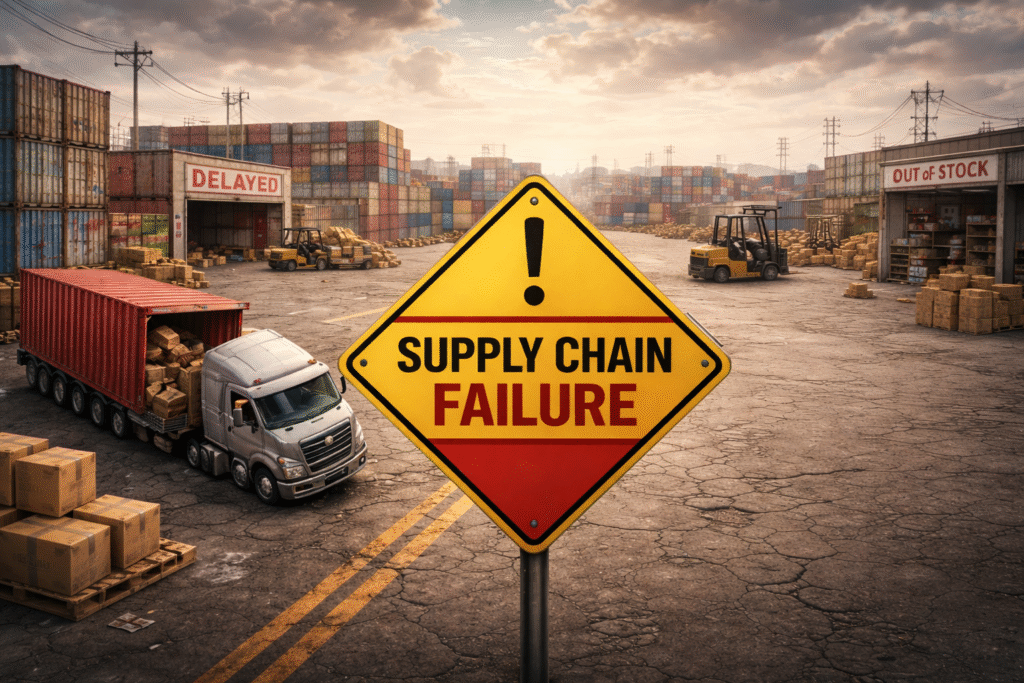
Supply Chain Failures: 7 Hidden Bottlenecks most businesses ignore, is a question that continues to challenge businesses across industries, geographies, and growth stages. Despite advancements in technology, process optimization, and logistics infrastructure, many organizations still struggle with recurring delays, rising costs, inventory imbalances, and inconsistent service levels. These issues are often dismissed as operational problems, but in reality, they are symptoms of deeper structural weaknesses.
A supply chain is not a linear flow of goods—it is a complex system of decisions, dependencies, and trade-offs. When even one element of this system is misaligned, inefficiencies begin to accumulate quietly. Over time, these inefficiencies transform into bottlenecks that restrict performance and resilience.
What makes supply chain failures particularly difficult to manage is that most bottlenecks remain invisible during stable periods. They surface only when demand fluctuates, volumes scale, or disruptions occur. By then, corrective actions are costly and reactive.
This blog examines seven commonly overlooked bottlenecks that silently undermine supply chain performance and explains why identifying and addressing them early is essential for building resilient, scalable supply chains.
1. Treating Supply Chains as Cost Centers Instead of Strategic Systems
One of the most fundamental reasons supply chains fail is the way they are perceived within organizations. When supply chains are treated purely as cost centers, decision-making becomes narrowly focused on expense reduction rather than system strength. This mindset encourages local optimization while ignoring end-to-end consequences.
Organizations operating with this perspective often prioritize the cheapest suppliers, minimize inventory without understanding demand variability, and delay investments in systems, infrastructure, or skilled talent. While such decisions may improve short-term financial metrics, they weaken the supply chain’s ability to absorb uncertainty and respond to change.
A supply chain designed only for efficiency performs well when conditions are stable. However, when disruptions occur—whether internal or external—these systems lack the flexibility to adapt. Minor issues then escalate into larger supply chain failures, exposing hidden fragilities.
Strategic supply chains are designed to balance cost, reliability, speed, and adaptability. They support business growth, protect customer experience, and enable faster decision-making. Elevating the supply chain from a support function to a strategic capability requires leadership alignment and long-term thinking.
Ignoring this strategic role is not a tactical oversight—it is a structural weakness. Until supply chains are treated as value creators rather than cost absorbers, hidden bottlenecks will continue to restrict performance.
2. Over-Reliance on Forecasts and Limited Demand Visibility
Forecasting is essential for planning, but problems arise when forecasts are treated as fixed truths rather than informed estimates. Many organizations rely heavily on periodic forecasts without building mechanisms to capture real-time demand signals. This creates a critical bottleneck that quietly destabilizes operations.
Demand is influenced by customer behavior, market conditions, promotions, seasonality, and competitive dynamics. Static forecasts struggle to capture this complexity. When supply chains fail to update plans dynamically, mismatches emerge between supply and actual demand.
The result is familiar: excess inventory of slow-moving products, stockouts of fast-moving items, and increased pressure on warehousing and transportation. Teams compensate through expedited shipments, emergency procurement, or excessive safety stock, increasing costs without solving the root problem.
Limited demand visibility also creates misalignment between sales, operations, and logistics. Sales teams may push aggressive targets without understanding supply constraints, while operations teams plan based on outdated assumptions. This disconnect gradually turns into persistent supply chain bottlenecks.
Effective supply chains treat demand planning as a continuous process. They rely on frequent data updates, cross-functional collaboration, and feedback loops. Without this dynamic approach, forecast-driven planning becomes a liability, leading to recurring supply chain management issues.
3. Fragmented Ownership Across Supply Chain Functions
A supply chain operates as a single system, yet many organizations manage it through fragmented functional ownership. Procurement, warehousing, transportation, production, and sales often work independently, each optimizing its own objectives. While individual functions may appear efficient, the overall system suffers.
Fragmentation creates conflicting priorities. Procurement may focus on bulk purchasing to reduce unit costs, while warehousing struggles with space limitations. Sales may commit to aggressive delivery timelines without understanding logistics capacity, forcing transportation teams into costly last-minute solutions.
When ownership for end-to-end performance is unclear, accountability weakens. Problems are escalated late, decisions are delayed, and teams resort to firefighting. These coordination gaps quietly evolve into supply chain bottlenecks that are difficult to diagnose because no single function owns the outcome.
True supply chain effectiveness requires integrated ownership and aligned incentives. Decisions must be evaluated based on their impact on the entire flow, not isolated KPIs. Shared performance metrics and cross-functional planning are essential to break silos.
Without unified ownership, even well-designed supply chains experience recurring supply chain failures, driven not by lack of effort but by structural misalignment.
4. Static Network Design in a Dynamic Business Environment
Many businesses design their supply chain networks once and then operate them unchanged for years. Warehouse locations, transportation routes, and distribution models remain fixed even as demand patterns, customer expectations, and volumes evolve. This static approach quietly erodes efficiency.
As markets expand or product portfolios diversify, the original network design may no longer support optimal service levels. Lead times increase, transportation costs rise, and inventory is positioned far from demand centers. These inefficiencies often go unnoticed because they develop gradually.
Instead of revisiting network design, organizations rely on operational workarounds—additional trucks, expedited shipments, or higher inventory buffers. While these measures keep operations running, they increase complexity and cost without addressing the root cause.
A supply chain network must evolve alongside the business. Periodic evaluation of node locations, flow paths, and service coverage is critical. Without this, inefficiencies harden into structural supply chain bottlenecks that are expensive to reverse.
Failure to adapt network design is a strategic oversight that directly contributes to higher costs, longer lead times, and declining competitiveness, ultimately resulting in avoidable supply chain failures.
5. Limited End-to-End Visibility and Information Flow
Visibility is the foundation of effective supply chain control. Yet many organizations operate with fragmented information systems that prevent a real-time, end-to-end view of operations. Data related to procurement, inventory, transportation, and order fulfillment often exists in silos.
Limited visibility delays problem detection. Inventory shortages, shipment delays, or capacity constraints are often discovered only after they impact customers. This forces teams into reactive responses rather than proactive adjustments.
Poor information flow also undermines decision-making. When data is incomplete or outdated, planners rely on assumptions instead of facts. Over time, this leads to overproduction, underutilized assets, and missed service commitments. These blind spots quietly become chronic supply chain bottlenecks.
Manual interventions increase as teams spend time reconciling data and chasing updates. While this keeps operations functioning, it reduces scalability and increases operational risk.
End-to-end visibility enables faster response, better coordination, and informed decision-making. Without it, even strong strategies fail in execution, contributing to recurring supply chain management issues.
6. Overdependence on Single Suppliers or Routes
Efficiency-driven strategies often push organizations toward supplier consolidation and fixed logistics routes. While this simplifies operations and reduces costs in stable conditions, it significantly increases vulnerability to disruption.
When a single supplier or route fails, the absence of alternatives can halt operations entirely. Recovery becomes slow and expensive because contingency options were never built into the system.
This risk is frequently underestimated during periods of stability. Concentration appears efficient until disruption occurs. At that point, what once seemed like a cost advantage becomes a critical supply chain bottleneck.
Resilient supply chains balance efficiency with flexibility. They maintain alternative suppliers, diversified routes, and adaptable sourcing strategies. This does not eliminate risk, but it reduces its impact.
Weak diversification is a persistent supply chain management issue that amplifies exposure. Organizations that fail to plan alternatives often experience disproportionate damage during disruptions, leading directly to supply chain failures.
7. Weak Execution Capability at the Operational Level
Even the best supply chain strategies fail if execution capabilities are weak. As businesses grow, processes that worked at smaller scales often break down. Execution gaps gradually undermine reliability and efficiency.
Common challenges include inconsistent operating procedures, inadequate training, and lack of performance measurement. These issues rarely cause immediate disruption but steadily erode service quality and cost control.
Weak execution also affects workforce morale. Teams operating without clarity or structure struggle to manage variability, leading to errors, burnout, and high turnover. Over time, these conditions create institutional fragility.
Execution capability requires disciplined processes, skilled teams, and continuous improvement. Without this foundation, even well-designed supply chains fail in practice.
Operational weakness is one of the most persistent supply chain bottlenecks because it is difficult to quantify and often overlooked until failures occur.
FROM BOTTLENECKS TO SYSTEM DESIGN
The most dangerous aspect of these bottlenecks is their compounding effect. Poor visibility worsens demand planning. Fragmented ownership delays response. Weak execution amplifies every disruption. Together, they explain why supply chain failures often appear sudden, even though their causes have existed for years.
Organizations that build resilient supply chains shift their focus from firefighting to system design. This involves aligning incentives, designing flexible networks, strengthening execution, and improving information flow. In practical operations, teams working closely with manufacturers and distributors—such as those at SMART SUPPLY CHAIN—observe that sustainable improvements come from disciplined design choices rather than isolated fixes.
CONCLUSION
Why Supply Chains Fail: 7 Hidden Bottlenecks Most Businesses Ignore highlights a critical reality: supply chain breakdowns are rarely caused by a single event. They are the result of accumulated structural weaknesses and unresolved supply chain management issues.
Businesses that proactively identify and address hidden supply chain bottlenecks can transform their supply chains into resilient, scalable systems that support growth and customer trust. In an increasingly uncertain environment, strong supply chain design is no longer optional—it is a competitive necessity.